
Last updated: October 31, 2026 · Written by Juan · Researched using ISHRS census data as reported by clinics and surgeon-published guidance on repeat procedures
This article is educational only. It is not medical advice, and I am not a doctor. Whether you need a second procedure, and when, depends on your donor supply and how your first result has settled, which only a surgeon examining you can judge. See our Editorial Policy for how we research and update our articles.
Needing a second hair transplant is not automatically a sign that the first one failed. According to ISHRS census figures from 2022, reported by The Private Clinic, 68.2% of patients needed one procedure and 28.6% needed a second. In other words, one procedure is the most common outcome, but a second one is far from unusual.
Why people go back
- Hair loss continues around the transplant. This is the most common reason. Transplanted grafts are usually stable, but the native hair around them can keep thinning unless it is protected with treatment, as covered in our guide to minoxidil, finasteride and surgery.
- The plan was always staged. The Private Clinic notes that only so many grafts should be used per session, so people with more extensive loss (see our Norwood scale guide) may need two sessions to reach their goal.
- The first result was not as dense as hoped. A second session can add density.
- Repairing earlier work, such as an unnatural hairline, low density or scarring, sometimes with a different surgeon. Our repair surgery guide covers this.
The real limit: how much donor hair is left
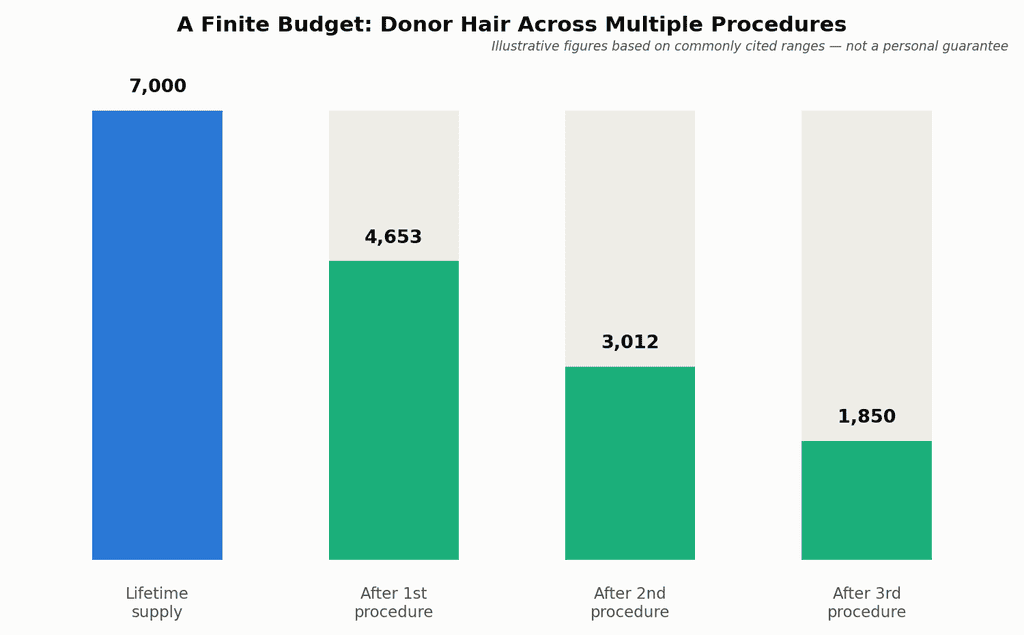
Donor hair is finite. Once it is used up, there is nothing suitable left to move. Medart Hair, a clinic, estimates total lifetime donor capacity at roughly 6,000 to 8,000 grafts across all sessions, and says most patients can have two or three sessions in a lifetime, depending on their donor supply. The Private Clinic cites a guideline that surgeons should not take more than 25% of the available donor hair in one session, so that enough remains for later.
The chart below is illustrative only. It shows how each procedure draws down a fixed supply; your own numbers depend on your donor density and scalp.
How long to wait
The Private Clinic says a second transplant should not be done before 12 months have passed, because recovery takes around a year and operating earlier could damage the donor area and the new follicles. Medart Hair suggests 12 to 18 months, or two to three years if hair loss is still progressing. An older answer from Bernstein Medical gives at least 8 months, with 10 to 12 ideal.
The reasoning is the same in all three: transplanted hair takes about a year or more to mature (see our recovery timeline), and the surgeon needs to see the full result before planning where new grafts should go. Bernstein Medical also notes that placing new grafts too close to existing ones can look unnatural. If a clinic offers to operate again well before a year, ask why.
What is different the second time
- Fewer grafts, used for fine-tuning. Bernstein Medical says a second session generally, though not always, uses fewer grafts, and is often used for fine-tuning rather than creating coverage from scratch, so the visible change can be smaller.
- Scar tissue in the donor area. After FUT, if the old scar is included in the new incision, Bernstein notes there may be slightly fewer hairs per graft. Medart Hair notes that a FUT scar can slightly reduce the area available for FUE, and that switching between techniques is a well-established approach.
- Often less shedding and swelling. Bernstein says patients generally see less shedding the second time, partly because weak hairs were already lost after the first session.
- Planning becomes more cautious. Because the remaining supply is smaller, a second consultation is a good time to discuss whether a third procedure would ever be realistic.
If scalp donor hair is very limited, beard or body hair is sometimes used as an extra source. Our body hair transplant guide explains the evidence and the limits.
Questions to ask before a second procedure
- How much donor hair do I have left, and what would this session leave for later?
- Which technique do you recommend this time, given what was used before?
- Is my current thinning because the first plan was staged, or because my native hair has kept thinning? Does that change what treatment I should be on?
- If this is a repair, what went wrong the first time and how will your approach avoid it?
Frequently asked questions
Does needing a second transplant mean the first surgeon did a bad job? Not necessarily. Continued hair loss around a transplant is biological and outside the surgeon’s control. It is a fair question about the first surgeon when the problem is design, technique or scarring.
Is a second transplant cheaper? Clinics usually price per graft in a similar way, so a second procedure often costs less in total because fewer grafts are needed. See our cost by country guide.
Can I go to a different clinic? Yes, and it is common for repair cases. Bring your original operative details (technique, graft count, dates) if you have them.
Is there a maximum number of transplants? There is no fixed number. It depends on donor supply and the condition of your scalp.
This article is for information only and is not medical advice. A qualified surgeon should assess your donor supply and timing before you plan any further procedure.
Sources consulted: