
Last updated: October 31, 2026 · Written by Juan · Researched using clinic-published crown restoration planning guidance
This article is educational only. It is not medical advice, and I am not a doctor. Whether crown restoration suits you depends on your donor supply, how your hair loss is progressing and your age, which a surgeon must assess in person. See our Editorial Policy for how we research and update our articles.
A hair transplant moves existing hair; it does not create new hair. That limit applies everywhere on the scalp, but the crown (also called the vertex, the whorl area at the top and back of the head) runs into it harder than anywhere else. The reasons have less to do with surgical skill than with the size of the area, the way the hair grows and how hair loss tends to progress.
Reason one: the crown uses a lot of donor hair
Donor hair is finite. Acibadem puts a typical lifetime supply at about 4,000 to 6,000 grafts, and Charles Medical Group uses an estimate of about 6,000. The crown is bigger than it looks: Charles Medical Group describes it as 60 to 100 square centimeters, which can take anywhere from 1,500 to 4,000 or more grafts. By its estimate, one large crown session of 2,500 to 3,500 grafts can use 40 to 60 percent of a lifetime supply.
That matters most for younger patients. Grafts spent on the crown early may not be available later if the hairline or mid-scalp also thin, which they often do, since the same process drives hair loss in all three areas. Our second transplant guide explains how donor supply is planned over a lifetime.
Reason two: the hair grows in a spiral
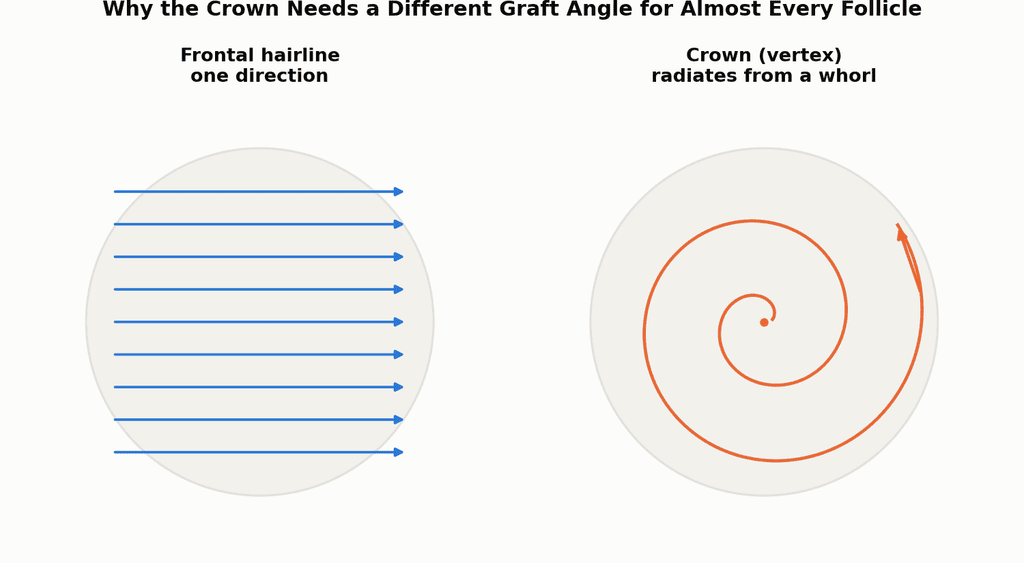
At the front, hair grows forward and the hairs overlap, so a modest number of grafts can create good coverage. At the crown, hair radiates out from a central whorl. As Acibadem puts it, “In a spiral, hairs point away from each other”, so more scalp shows between hairs at the same density. The whorl can turn clockwise or counter-clockwise, and some people have two or three whorls.
This affects both the surgery and the result. The surgeon has to change the angle of the grafts continuously to follow the spiral, and if the center of the whorl or the angles are wrong, the result can look artificial. Even with good technique, some see-through appearance at the crown is normal, especially from above and under bright light. Knowing that in advance helps avoid reading it as a failure.
Reason three: the “island” effect
Transplanted hair comes from the donor area, which is generally resistant to DHT, the hormone behind pattern hair loss. The native hair around a crown transplant is not. Over the years, it can keep thinning while the transplanted hair stays, leaving an isolated patch surrounded by bare scalp. Charles Medical Group notes that this patch cannot be removed without scarring.
This is why the crown can look good at 12 months and patchier years later, and why medication to protect the surrounding hair is so often recommended for crown work. Charles Medical Group says the crown responds to DHT blockers better than the hairline does, and that stability usually needs 12 months or more of documented treatment before surgery is considered. Our guide to minoxidil, finasteride and surgery covers the options and the side effects to discuss with a doctor.
Slower growth and lower survival
Charles Medical Group gives graft survival in the crown of about 85 to 92 percent, compared with 90 to 95 percent at the hairline, and full maturity at 15 to 24 months instead of 9 to 12. If you are comparing your progress with our recovery timeline, expect the crown to run behind it.
The decision that matters most: what to do first
Both sources recommend the same strategy. Treat the front first, because it frames the face and gives more visible impact per graft, and assess the crown later. Charles Medical Group suggests reviewing the crown 12 to 18 months after the hairline, once you can see how the rest of your hair loss is behaving. Acibadem describes a hybrid plan in which most grafts go to the front and a lighter crown pass of about 800 to 1,200 grafts is added, keeping reserves for later.
Doing the crown first, before the pattern is clear, is a common source of regret. The crown work itself may be fine, but it commits donor hair before the full picture is known. A Norwood 3 or 4 pattern today does not guarantee it will stay there; our Norwood scale guide and our article on transplants at a young age explain why.
Questions to ask a surgeon about crown work
- If I use grafts on my crown now, how many will be left if my hairline or mid-scalp thin later?
- Where is the center of my whorl, and how will that shape the angle plan?
- What survival rate and timeline should I expect for the crown specifically?
- Would you treat the hairline first and revisit the crown later? If not, why not in my case?
- Which medication do you recommend to protect the hair around the transplanted area?
Frequently asked questions
Do surgeons ever advise against crown work? Yes, particularly for younger patients whose hair loss is still progressing. A surgeon who raises this, rather than agreeing straight away, is usually a good sign. Our regret guide covers similar situations.
Does the island effect mean the transplant failed? No. The transplanted hair usually stays. What changes is the hair around it.
How many grafts does the crown need? Acibadem gives about 500 to 1,000 grafts for early thinning at the whorl, 1,000 to 2,000 for moderate loss, and 2,000 to 3,000 or more for advanced loss, sometimes over two sessions. Our cost by country guide explains how graft count affects price.
Can the crown and hairline be done in the same session? Technically yes, but for younger patients or anyone whose hair loss is not yet stable, many surgeons prefer to stage them.
This article is for information only and is not medical advice. A qualified surgeon should assess your donor supply and hair loss before you decide on crown restoration.
Sources consulted: