
Last updated: October 31, 2026 · Written by Juan · Researched using ISHRS terminology guidance and clinic-published candidacy data
This article is educational only. It is not medical advice, and I am not a doctor. Whether an unshaven approach suits you depends on your donor hair length and density and on how many grafts you need, which a surgeon has to assess in person. See our Editorial Policy for how we research and update our articles.
“Unshaven FUE” is one of the least consistently used terms in hair restoration. It is also very effective marketing, because it removes the main reason many people put off a transplant: not wanting a shaved head for weeks. That gives clinics a reason to stretch the term, so it pays to know exactly what you are being offered.
Three different procedures sold under one name
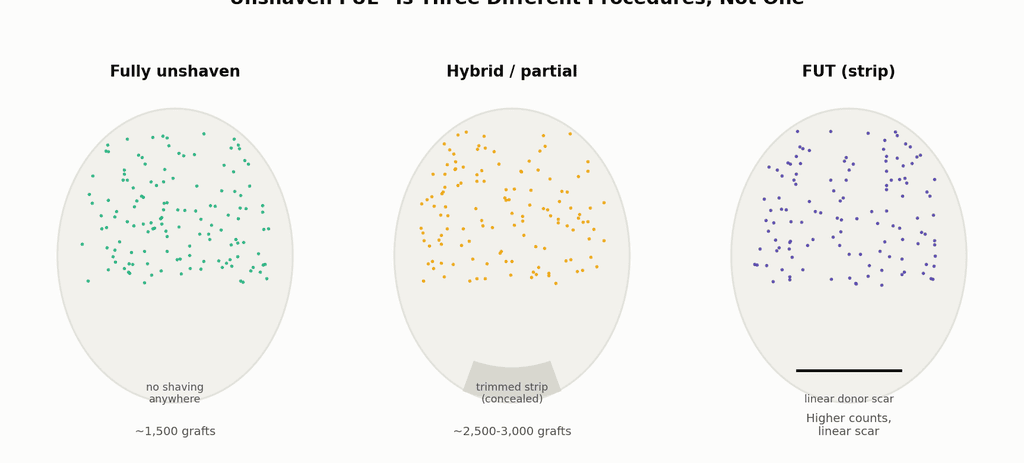
The International Society of Hair Restoration Surgery (ISHRS) distinguishes between fully shaven, partially shaven and unshaven FUE. Charles Medical Group groups the “no-shave” options patients are offered into three types:
- Fully unshaven FUE. Neither the donor area (back and sides) nor the recipient area is shaved. The ISHRS explains that the surgeon either trims each target follicle with scissors or cuts the hair with the punch during extraction. Working through long hair reduces visibility, and Charles Medical Group puts a realistic session at about 1,500 grafts.
- Partial or hybrid FUE. The ISHRS describes lifting the hair, shaving a zone for extraction and letting the hair fall back to cover it; with shorter hair, several narrow zones can be used. Because more donor area is reachable, Charles Medical Group says sessions can reach roughly 3,000 grafts.
- FUT (strip surgery). The donor strip can be removed without shaving, and the closed wound is hidden by the surrounding hair. The trade-off is a permanent linear scar, covered in our guide to FUE and FUT scars.
The “hidden shave” problem
Charles Medical Group warns that some clinics advertise no-shave FUE while still shaving a block of the donor area and relying on longer hair above it to cover the patch. As it puts it, “A concealed block shave is not a no-shave procedure.” If you expect no shaving at all, a shaved patch you cannot see in the mirror can be an unwelcome surprise.
Two ways to avoid it:
- Ask the clinic to confirm in writing whether any part of the donor area will be shaved, where, how wide, and how it will be hidden. A simple diagram helps.
- Ask for photos of real patients taken on the day of surgery and the day after, not edited marketing images. A shaved patch shows up clearly in those. Our guide to spotting misleading before/after photos explains what to look for.
Who qualifies for fully unshaven FUE
Charles Medical Group lists these as the typical criteria:
- Early to moderate hair loss, around Norwood 1 to 4. People at Norwood 5 to 7 usually need more grafts than this approach can provide. See our Norwood scale guide.
- Donor hair of at least about 1.5 inches, long enough to hide the extraction sites while they heal.
- Good donor density, since thin donor hair hides less, whatever its length.
- No dyed hair in the donor area, which the same source lists as a contraindication.
- A moderate graft target. Larger needs may mean several sessions, or a partial-shave approach.
Women are often good candidates, partly because their hair loss is usually diffuse and partly because a shaved head is a bigger change for most women. Our female hair transplant guide covers this.
The trade-offs
- Higher risk of damaging grafts. The ISHRS notes that long-hair unshaven FUE is technically demanding and can increase the transection rate, meaning follicles are cut during extraction. Surgeon skill matters more than usual.
- Longer sessions. Charles Medical Group gives 6 to 10 hours for no-shave sessions. Grafts spend longer outside the body, so handling and storage matter.
- Care with long hair afterwards. The ISHRS stresses the importance of showing patients how to wash and comb long transplanted hair without pulling grafts out.
- No faster results. Final results still take 12 to 18 months, as our recovery timeline shows.
There are upsides beyond discretion. The ISHRS notes that keeping the donor hair long lets the surgeon watch for visible thinning while extracting, which helps avoid over-harvesting. Leaving recipient hair long also allows a “long-hair preview” of the immediate result.
Questions to ask before booking a “no-shave” procedure
- What exactly will be shaved, if anything, in the donor and recipient areas? Can you confirm it in writing?
- Can I see day-of and day-after photos of recent patients?
- Can my graft target be reached in one unshaven session, or will I need several sessions or a partial shave?
- Will the surgeon personally do the extraction? This matters more here because the technique is harder. Our guide to choosing a clinic explains why.
- What happens if, on the day, I need more grafts than an unshaven session allows?
Frequently asked questions
Is unshaven FUE more expensive? It often is, because it is slower and more demanding, but there is no fixed premium. Ask your clinic for a direct price comparison. Our cost by country guide gives general price context.
Does it damage more grafts than shaved FUE? The risk is higher, which is why it is reasonable to ask a clinic for its own transection rate for unshaven procedures specifically.
Is FUT the same as “no-shave”? Only in the sense that the donor area does not have to be shaved. It leaves a linear scar, which is a different trade-off rather than a better one.
This article is for information only and is not medical advice. Confirm in writing exactly what will and will not be shaved before booking with any clinic.
Sources consulted: