
Last updated: October 31, 2026 · Written by Juan · Researched using hairline design guidance published by hair restoration surgeons
This article is educational only. It is not medical advice, and I am not a doctor. Hairline design is planned with a surgeon who examines your scalp, your pattern of hair loss and your donor supply. No article can design yours. See our Editorial Policy for how we research and update our articles.
A common situation in surgeons’ writing: a patient brings a photo of themselves at 19, with a low, straight hairline, and asks for exactly that. A careful surgeon will often suggest something different. It can usually be built, but it is often the choice that ages worst.
A natural hairline was never a straight line
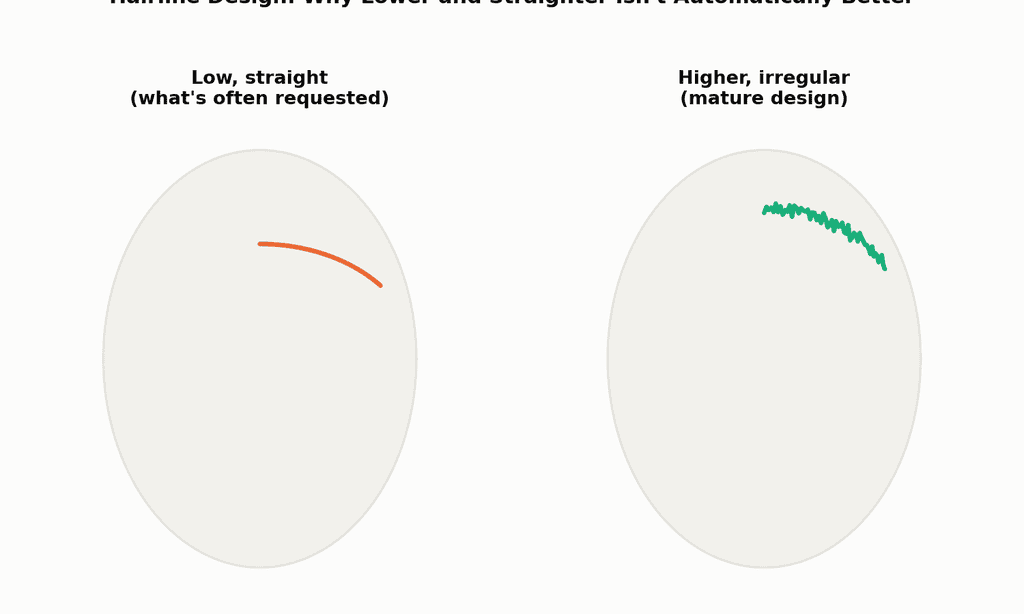
Natural hairlines are irregular. Dr. Viral Desai, writing for IMCAS, recommends a zig-zag first row rather than a straight one and says a hairline should not be perfect or absolutely symmetrical. Kopelman Hair Restoration describes the same idea as keeping small and large irregularities along the edge, so that the line does not look uniform.
The front edge is also soft. Kopelman describes a transition zone about 0.5 to 1 cm deep, made of single-hair grafts at the lowest density, with density increasing gradually behind it. A sudden “wall” of hair, or multi-hair grafts in the front row, is one of the things that makes a transplant look obvious.
Why lower is not automatically better
A low, youthful hairline has two problems that often show up only years later:
- It may not match the hair loss that comes next. If the hair behind and around a low, dense hairline keeps thinning, the new hairline can end up looking like an isolated strip in front of a thinning scalp. Our guides on transplants at a young age and the crown describe the same problem in other areas.
- It uses a lot of donor hair. Every graft placed at the front is one that cannot be used further back later. Kopelman advises being conservative when donor supply is limited, and our second transplant guide explains why that supply is finite.
Dr. Desai’s rule of thumb for doubtful cases is to place the hairline higher, because it can always be brought forward later. The reverse is much harder.
What a “mature” hairline means
Instead of copying a teenage hairline, many surgeons aim for one that would suit you over decades. Dr. Desai describes the goal as an “ageless” hairline that should suit a 20-year-old as well as a 65-year-old. In practice that usually means slightly higher and softer than a teenage hairline, with natural irregularity.
Some of the measurements surgeons use as starting points:
- Height. Kopelman calls the familiar “four fingers above the eyebrows” rule only a rough starting point and adjusts for bone structure, the extent of hair loss and donor supply.
- Temples. Dr. Desai suggests the outer corners of the frontal hairline usually line up with a vertical line from the outer corner of the eyes. Kopelman notes that flattening or overfilling the angle at the temples is a common mistake that looks artificial.
- Angle of the hairs. Kopelman gives roughly 15 to 20 degrees along the front, and 5 to 10 degrees at the temples, matching how natural hair grows out of the skin.
These are general figures. Your surgeon adjusts them to your face, age, Norwood stage and family history (see our Norwood scale guide).
The conversation to have with your surgeon
If you have a strong view about your hairline, that is reasonable. The useful version of the conversation is not “give me exactly this”, but asking the surgeon to explain why they recommend what they do, and pushing back if the reasoning does not fit your case. A surgeon who agrees to whatever you ask without discussing future hair loss and donor supply is skipping an important step, a point we also make in our guide to choosing a clinic.
Questions worth asking:
- Why this height and shape for me? Walk me through your reasoning.
- How does this design allow for my hair loss progressing?
- Will my donor supply cover this hairline and the areas behind it if I need them later?
- Can you show me hairlines you have done, at 12 months or more, on patients who started where I am?
Frequently asked questions
Can I still have a lower hairline if I really want one? Often yes, within limits. A responsible surgeon will explain the costs in donor hair and the risk from future hair loss first.
Is hairline design different for women? Yes. Women’s hair loss is often diffuse rather than a receding line. Our female hair transplant guide covers this.
Is a mature hairline the same as a receding one? No. A mature hairline is a deliberate design meant to look natural for a long time. A receding hairline is untreated hair loss.
Will a poor design show straight away? Some mistakes, such as a perfectly straight edge, show as soon as the hair grows. Others, such as a hairline set too low for your future hair loss, show only years later.
This article is for information only and is not medical advice. Plan your hairline with a qualified surgeon who has examined you.
Sources consulted: