
Last updated: October 18, 2026 · Written by Juan · Researched using NHS, American Academy of Dermatology and Cleveland Clinic patient guidance, plus clinic-published walkthroughs (linked below)
This article is educational only. It is not medical advice, and I am not a doctor. Every clinic runs the day differently, and your surgeon’s written instructions always come first. See our Editorial Policy for how we research and update our articles.
Most of the anxiety before a hair transplant comes from not knowing what the day will be like. Will you be asleep? Will it hurt? How long will you be there? The answers are more reassuring than most people expect, but they also vary by clinic and technique, so it helps to know what is standard and what isn’t. This guide walks through the day in order and tells you where the sources agree and where they differ.
The short version
| Question | What the sources say |
|---|---|
| Will I be asleep? | Usually not. The American Academy of Dermatology (AAD) says most patients remain awake and need only an anesthetic that numbs the scalp, and some also take a mild sedative. The NHS says you’re awake but will not feel any pain. |
| How long does it take? | The AAD says four to eight hours. The NHS says it usually takes a day. Large sessions may need a return visit or a second session. |
| Do I stay overnight? | Generally no. The NHS says you should not need to stay overnight, and Cleveland Clinic describes most transplants as outpatient procedures. |
| Can I just walk out after? | You go home the same day, but arrange a ride. The American Society for Dermatologic Surgery (ASDS) advises arranging a ride home because most procedures are outpatient. |
Before the day: what the consultation sets up
The surgery day should be the last step, not the first. By then you should already have had a scalp exam and a conversation about whether you’re a suitable candidate (see what surgeons actually check). The AAD notes that a consultation includes a scalp exam and that some patients need blood tests or a scalp biopsy. The ASDS advises stopping smoking two weeks before surgery. Your clinic may give you its own list, so follow that over any general advice, and tell the surgeon about every medication and supplement you take. Our guide to alcohol, smoking and exercise explains why surgeons care about these.
The day, step by step
The sequence below follows a walkthrough published by one London clinic, which describes a day of roughly 5 to 8 hours, cross-checked against the AAD and NHS descriptions of the same stages. Treat the timings as an example from one clinic, not a standard. The clinic is also promoting its own services, so I’ve used it for the order of events rather than for any claim about quality.
1. Arrival and consent. You arrive in the morning. The doctor reviews the plan with you, takes consent forms, and checks your blood pressure. This is your last chance to ask questions or change your mind, and a good clinic expects that.
2. Marking the design. The surgeon draws the planned hairline and recipient area with a surgical marker, and the head is typically shaved, fully or partly depending on the technique. How the hairline is drawn is the decision that shapes the final look, and our article on hairline design explains what to look for. Check it in the mirror before you go further.
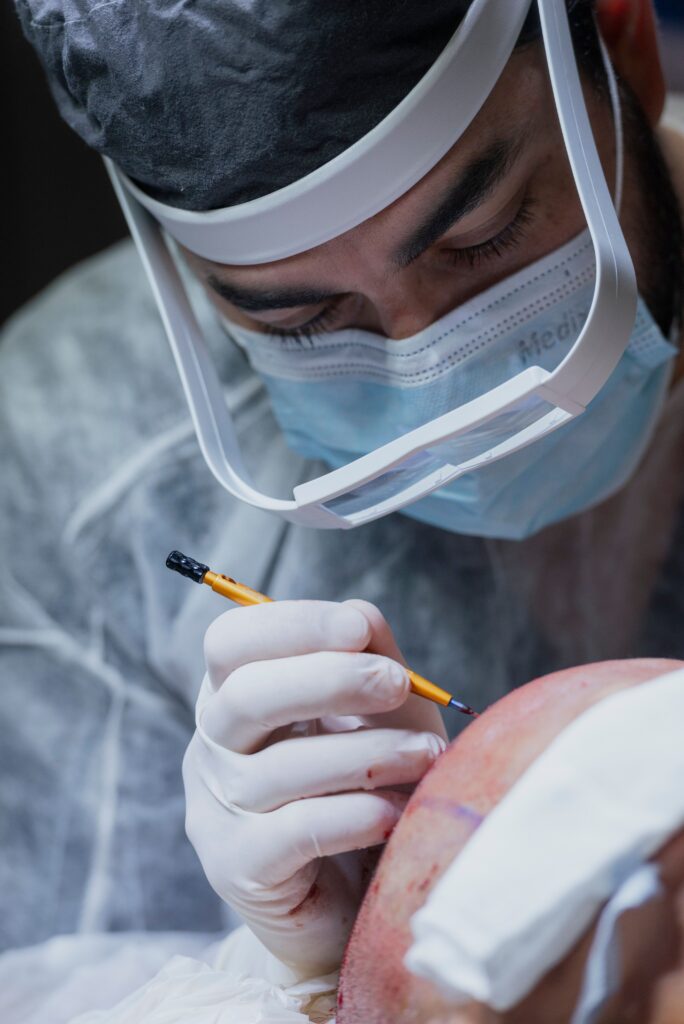
3. Numbing the donor area. A local anesthetic is injected where the grafts will be taken, usually the back of the scalp. You’ll feel a sting while it goes in, and then the area is numb.
4. Taking the grafts. In FUE, individual follicles are removed one at a time. In FUT, a strip of scalp is taken and divided into grafts, leaving a linear scar. The NHS describes both methods, and our FUE vs FUT comparison goes through the trade-offs. This stage is typically one of the longest, and you may feel pressure or tugging without pain.
5. A break while grafts are prepared. The London clinic describes a break of about 20 minutes during which staff count and sort the grafts by number of hairs. Most clinics build in breaks for food, toilet visits, and stretching.
6. Numbing the recipient area and making the sites. The area receiving the hair is anesthetized, and the surgeon makes tiny incisions that set the angle and direction of the new hair. The angle and direction of these sites are what the grafts will follow, which is why surgeon skill matters at this step.
7. Placing the grafts. The AAD says two to three team members place the hairs in the thinning area, and the London clinic says technicians do this. That is common and not necessarily a problem, but it is a reason to ask exactly who does which step (more on that below).
8. Dressing and discharge. The scalp is bandaged, you get written aftercare instructions and usually a kit, and you go home. The clinic above describes a headband to limit swelling, special shampoo, and a saline spray, and advises sleeping upright for the first 3 to 5 days. Those details are that clinic’s protocol, so don’t assume yours is identical.
What it feels like
The sources agree that the numbing injections are the part you feel, and the NHS says you won’t feel pain once you’re numb. Because you’re awake, clinic walkthroughs describe patients watching a screen or using their phones during breaks. Once the anesthetic wears off in the evening, the scalp can feel tight, sore, or swollen, which the NHS lists as a common side effect for a few days along with temporary scabbing. If pain is severe or keeps increasing, call the clinic. Don’t wait it out.
What can go wrong on the day
Hair transplants are generally considered safe, but they’re still surgery. The NHS lists bleeding, infection, and an allergic reaction to the anesthetic among the possible complications, and Cleveland Clinic lists similar risks along with scarring and loss of scalp sensation. Our overview of complications and real risks explains the less common ones. Tell the team immediately about any allergy or any reaction, however mild.
Questions to ask before you book
- How many grafts are planned, and roughly how many hours will it take? The day is long, so the answer shapes how you plan it.
- Who will perform each step? Ask specifically who makes the incisions and who places the grafts. The NHS suggests asking about the surgeon’s qualifications, experience, and complication numbers, and our guide to choosing a clinic safely covers what to check.
- Will it be one session or more? The NHS says larger areas may need two or more sessions on different days.
- What aftercare is included, and who do I call if something worries me? Make sure you have a direct contact, especially if you’re traveling. See our guide to flying and traveling home.
What happens next
The day itself is only the start. The grafts are fragile for the first two weeks, according to the NHS, and shedding and regrowth follow over many months. Our recovery timeline shows what to expect at each stage, including the shedding phase that worries so many people.
Quick answers
Is a hair transplant painful? The numbing injections sting briefly, and the sources describe the rest of the procedure as pain-free. Soreness afterwards is common and usually temporary.
Can I eat and take breaks during surgery? Clinics generally build in breaks. Ask yours how it handles meals and what you should do about eating beforehand.
How long should I plan for? Four to eight hours is the AAD’s range for the surgery itself, and you should add time for consent, marking, breaks, and discharge. Larger cases can take longer or be split across days.
Will I need someone to take me home? Yes, plan for it. The ASDS advises arranging a ride, and most people are tired and sore afterwards.
This article is for information only and is not medical advice. Always follow the written instructions from your surgeon, and consult a qualified, licensed professional before making any decision about treatment.
Sources consulted: NHS: Hair transplant; American Academy of Dermatology: Hair transplant; Cleveland Clinic: Hair transplant; American Society for Dermatologic Surgery: Hair transplants; Harley Street Hair Transplant: What happens during a hair transplant procedure?.