
Last updated: October 16, 2026 · Written by Juan · Researched using clinic-published guidance, a hair restoration textbook chapter on ethnic considerations, and dermatologist-published guidance on scarring hair loss
This article is educational only. It is not medical advice. Hair type is only one of many factors in a transplant, and suitability depends on your specific type of hair loss, which only a qualified doctor can assess in person. See our Editorial Policy for how we research and update our articles.
Most hair transplant content is written, illustrated, and photographed around straight or wavy hair. If you have tightly curled or coily hair, many of the standard assumptions about how the procedure works and how it looks afterward need a second look. This guide explains what’s different, which questions matter most, and why surgeon experience with your hair type is more important than usual.
Why curly and coily hair is a different technical problem
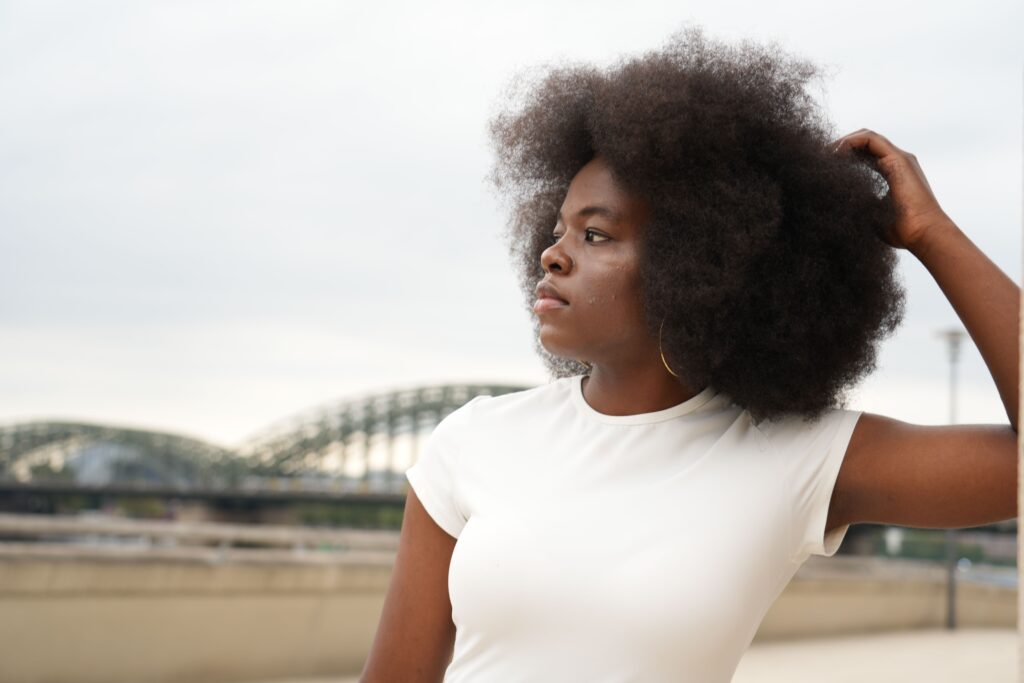
The key difference is invisible from the outside: the hair follicle itself is curved beneath the skin. In straight hair, a follicle goes down in a relatively straight line, which makes it easier to extract intact. In tightly curled hair, the follicle bends, sometimes quite sharply, as it goes deeper into the scalp.
That curvature has practical consequences:
- Higher risk of transection during extraction, meaning the follicle is cut partway and the graft is damaged, which can lower the number of grafts that survive.
- Harder to predict the angle of the follicle from the surface, since the visible hair doesn’t show where the root bends.
- Greater dependence on the surgeon’s skill and on the tools they choose. The technique and equipment that work smoothly on straight hair don’t always transfer well. Surgeons experienced with this hair type often use angled or hybrid punches rather than straight ones, chosen to match the follicle’s own curvature.
This is the reason experience with your specific hair type matters, and why we flag it in our FUE vs FUT comparison and our look at robotic vs manual FUE.
FUE, FUT, and scarring
There is no single “best” technique for everyone with afro-textured hair. Two points shape the decision:
Scarring. Many surgeons favor FUE for patients with this hair type, mainly because it avoids the linear scar of a strip incision and lets you keep your hair very short without a visible line. Keloid and hypertrophic scarring, where the body produces thicker, raised scars, are reported as significantly more common in Black patients. Charles Medical Group’s guidance on hair restoration for African American patients cites a 7 to 15 times higher likelihood of head and neck keloids compared to patients of European ancestry, with keloid rates after hair transplant generally under 1–5%, but rising to as high as 15.1% with strip (FUT) surgery in patients with darker skin or a genetic predisposition. If you’ve ever had keloids from piercings, cuts, or acne, tell your surgeon at the consultation, because it can affect which technique they recommend. Our guide to FUE vs FUT scarring shows what each scar pattern looks like.
Extraction difficulty. FUE avoids the linear scar, but it is also where the curved-follicle problem shows up, since the surgeon can’t see the root while extracting. Some clinics point out that FUT can protect curved follicles better because each one can be seen under a microscope after the strip is removed, at the cost of the scar. In FUE, surgeons commonly describe careful technique, well-chosen tools, and a slower, more deliberate extraction pace as the way to keep transection low. This is why many clinics recommend a surgeon who regularly performs FUE on curly hair rather than one who mostly treats straight-haired patients.
Robotic systems and curly hair
As covered in our ARTAS vs manual FUE article, automated systems have historically worked best on dark, straight hair with good contrast, and curlier textures have been flagged as harder for them to map accurately. Manual FUE is often preferred for very tightly coiled hair specifically because the extraction angle has to be adjusted constantly, follicle by follicle. Technology keeps improving, so the practical question to ask any clinic is not “do you use a robot?” but “how many procedures like mine have you done, and what were the outcomes?”
Density and appearance: why curls can help
One of the less obvious facts about afro-textured hair is that it is generally described as having a lower follicle density per square centimeter than straight hair, yet it can look fuller. The curl lifts the hair away from the scalp and covers more surface area per strand, so a lower graft density can create the appearance of good coverage.
That means:
- Graft counts and density targets that make sense for straight hair don’t always translate directly.
- Donor density itself can look higher than it is on visual inspection, because the curl obscures the scalp, which is why calibrated density measurement, not a visual estimate, matters for planning.
- Results photos from someone with straight hair are a poor guide to what to expect for your own hair. See our guide to spotting misleading before/after photos and ask to see examples on hair like yours.
Hairline design and natural look
Hair that curls grows out of the skin at different angles and in different directions than straight hair, so the planning of angle and direction matters. Surgeons who work with this hair type often stress that a design copied from straight-hair cases can look out of place. Look for a surgeon who can show you hairlines on patients with hair like yours, and who can explain how they plan the angle and direction. Our article on hairline design explains the general principles.
Check the type of hair loss first
Not every kind of hair loss is suitable for a transplant, and some conditions are more common in people with afro-textured hair. Three distinctions are worth knowing:
- Traction alopecia (from tight hairstyles over many years) needs to be identified or ruled out before surgery. Early stages may still be reversible with non-surgical treatment such as PRP; more advanced, scarred stages may be transplant candidates, but only once the damaging hairstyles have stopped and the hair loss has been confirmed stable.
- Scarring (cicatricial) alopecias, such as central centrifugal cicatricial alopecia (CCCA), involve active inflammation that destroys follicles, including newly transplanted ones if surgery happens too soon. These need to be evaluated and stabilized by a dermatologist first. Dermatologists who write about this describe transplantation as something considered only after the condition has been quiet for a long time, often one to two years, and not while it is active.
- Acne keloidalis nuchae and dissecting cellulitis, both more common in this population, also need to be managed before surgery: acne keloidalis specifically in the donor zone can compromise graft quality there.
If your hair loss has a pattern that isn’t typical male or female pattern baldness, getting a diagnosis from a dermatologist before booking any clinic is a sensible first step.
What to ask at the consultation
- How many FUE procedures have you performed on afro-textured hair? Ask for the number, not just “plenty.”
- Can I see results from patients with hair like mine? Ask for unedited photos, taken at 12 months or later.
- What is your assessment of my scarring risk? Mention any history of keloids.
- How do you handle curved follicles during extraction? A confident, specific answer is a good sign.
- Would you do a test graft first? A small test session to check transection rate and healing before committing to a full procedure is a reasonable ask given the higher technical difficulty.
- What happens if some grafts are damaged? Ask how the clinic handles that situation.
The general clinic-vetting checklist still applies. If you are in the UK, our UK clinics guide explains how to check a clinic’s regulator rating and surgeon credentials, and for the risks to ask about in general, see our overview of complications.
After surgery: hairstyles
Ask your surgeon how long to avoid tight hairstyles such as braids or cornrows after the procedure. Some clinics advise staying away from them for several months, since pulling on the scalp is exactly what you want to avoid while grafts settle. Your clinic’s written instructions come first, and our recovery timeline shows what the scalp is doing at each stage.
Quick answers
Can people with afro-textured hair have a hair transplant? Yes, when they are a suitable candidate. It requires a surgeon with specific experience, since the technique is more demanding.
Is FUE or FUT better for afro-textured hair? Many surgeons favor FUE because it avoids a linear scar, but there is no single answer. It depends on your scarring history, your hair, and the surgeon’s experience.
Will the transplanted hair look natural? It can, when the hairline, angle, and density are planned for your hair type.
Should I choose a clinic mainly by price? No. For this hair type especially, surgeon experience is a more useful comparison than the lowest price.
This article is for information only and is not medical advice. Always consult a qualified, licensed surgeon or dermatologist before making any decision about treatment.
Sources consulted: Charles Medical Group’s guidance on hair restoration for African American patients; a hair restoration textbook chapter on ethnic considerations in hair restoration surgery; a board-certified dermatologist’s published guidance on hair transplantation for central centrifugal cicatricial alopecia.